Of all the articles that I have written, I consider this article of Wine Journal to be my best article. Hope you feel the same too.
Eggnog, Wassail, Hot Wine -- Oh My!
It is a cold winter night outside while inside a group of family and good friends is clustered around a crackling fire, thinking how wonderful the party foods look, tucked here and there throughout the living room. The genial host grandly sets down a huge bowl of Christmas cheer on the table near the fire. What is this? Eggnog! The crowd good-naturedly surges forward as one to the punch bowl, eagerly clamoring for a cup of alcohol-enhanced ambrosia. Such a fantastic tasting experience! If it is eggnog, then we are celebrating the holiday party-filled days between Thanksgiving and New Year's Day. Happy times for all are coming.
Reaching back in history to about 1775, eggnog enjoyed popularity on both sides of the Atlantic Ocean, from England to America. The word "no" in eggnog is thought to have come from an object known as a "noggin," a small mug made of carved wood. This wooden mug was used to serve drinks to the tavern patrons seated at tables; tankards were used to serve drinks at fireside. (Was this elementary fire protection, assuming the tankards were constructed of metal or some other fire-resistant material?) The eggnog drink itself is descended from a hot British drink known as "posset" which contained eggs, milk, and ale or wine. (Sugar was added some time down the timeline.) Eggnog is used as a toast to ensure everyone's good health in the year to come. It had many silly-sounding (but memorable) names including egg-flip, egg-hot, and of course eggnog.
Eggnog, in the 18th century, was considered a beverage for the well-off. Milk was quite expensive and therefore economically out-of-bounds for most people. When eggnog made its way over to America, it became easily accessible to all classes because of the large numbers of milk cows there. To give the drink a little "oomph," rum was often mixed into the eggnog. Rum was relatively inexpensive compared to other alcoholic drinks and easy to obtain, making it the perfect additive.
American Colonial history dictates that there were at least a few special occasions involving eggnog and high society. In Baltimore, Maryland, etiquette demanded the practice of young men calling upon all their friends on New Year's Day. At each visitation made, the men were offered a cup of eggnog. Not wanting to offend anyone by refusing the proffered cup of cheer, the gents became, in a word, "sloshed" and could barely get back to their own homes.
It was also accepted as doctrine that President George Washington, the Father of America, was an extreme fan of eggnog. He concocted his own version of eggnog which included sherry, rum, and rye whiskey. Only the bravest of his friends were willing to try it.
When thinking about eggnog on a cold winter night, we should always remember the joys of wassail and hot mulled wine, as well as their companion, hot hard cider.
Rather than originally being a drink, wassail first embraced caroling. Some centuries ago, groups of carolers brought cups with them, and while they performed at the doors of the rich, a servant would fill their cups with hot spiced ale, frequently topping off the drink with a floating roasted apple slice.
Hot mulled wine has been popular for centuries. "Mulled" means heated and spiced, making this drink perfect for those cold winter nights. In medieval times, these drinks were named after Hippocrates, the father of medicine, public opinion being that hot wine must be healthier than drinking the polluted water which was available to the masses.
By 1500, cookbooks included various methods of mulling wine. In addition to French wine, honey, cinnamon, cardamon, and galingale (a pungent, aromatic plant related to ginger) were added to the warming mixture. In Victorian England, "Negus," a version of mulled wine, was served to children at their birthday parties. Mulled wine has been a party drink for hundreds of years.
Some mulled wines are similar to today's sangrias, sometimes using white wine in place of red. All sorts of things are added in, including oranges, cloves, twelve spice, and more. Do not forget a couple of sticks of cinnamon.
Last, but certainly not the least, is cider. Its use was known of in England before the time of Christ. The apples used to make the cider were rumored to have come from sacred trees.
There was no such thing as alcohol-free cider in years past. Everyone, including pious clergymen and small children, drank cider as matter of course. The cider was not sweet, as there was no refrigeration available. Modern refrigeration has made sweet (nonalcoholic) cider extremely popular. Alcoholic cider is now known as "hard" cider.
Be sure to buy pasteurized cider for your holiday parties as E. coli can lurk hidden in unpasteurized cider.
To your good health! Cheers! L'chaim! Skoal! Bottoms up! Have a happy, healthy, and prosperous New Year.
About the Author
Terry Kaufman is Chief Editorial Writer for Niftykitchen.com, Niftyhomebar.com, and Niftygarden.com.
?2006 Terry Kaufman. No reprints without permission.
Short Review on Wine Journal
Marketing Wine on the Internet
The Australian Wine industry is experiencing a tough time as oversupply of product is creating downward pressure on prices. Large producers have had ...
The Wine Messenger
Click Here to Read More About Wine ...
Featured Wine Journal Items
Another Great Wine Selection To Visit

Another Great Wine Selection To Visit
Morrell Wine
Black & Cherry Finish Wine Rack w/12 Bottle Wine & Ice Bucket Storage
 Product Description
Black & Cherry Finish Wine Rack w/12 Bottle Wine & Ice Bucket Storage This is a brand new in box wine rack with storage in black finish iron metal and cherry finish wood top that is 100% hand crafted to perfection. The rack can hold up to 12 bottles of wine and also has a section to hold your wine glasses as well. Impress your friends at your next dinner party with this elegant item that is practical in use and beautiful for home decor use. Item also comes with an Ice Bucket combo that sits on top of the fabulous piece. Make this item yours today or give it away as a perfect Gift! Item requires simple assembly Dimensions of the item measures: 23.75"W x 13.5"D x 37.75"H
List Price: $189.99
Click image to see best discounted price.
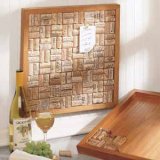
Wine Cork Bulletin Board Kit
 Product Description
Pop those wine corks...and create a wine cork bulletin board. Our wine cork kits are one of our most popular products, since half the fun is in the making! The bulletin board in maple is perfect for the kitchen, home office, or wine cellar. We supply the oak frame, mounting board, glue and instructions. You supply the wine corks. Gift boxed. Size: 16"L x 16"W Also available in Black and/or Smaller. Approximately 128 wine corks are required to complete bulletin board kit. Note: Wine corks vary in size
List Price: $24.95
Click image to see best discounted price.
Cuisinart CWC-600 Private Reserve 6-Bottle Stainless-Steel Countertop Wine Cellar
 Product Description
Protect your wines when storing, and then chill them to their proper serving temperature, with this convenient countertop wine cellar. Its clean thermoelectric technology is vibration free and virtually silent. Choose one of eight preset temperatures for a variety of reds or whites; or enter a manual setting on the LED readout. Holds six standard 750ml bottles on three chrome racks; racks are removable for champagne in 1500ml magnums. Features a double pane tinted view window and interior light. Attractive cellar with stainless steel finish is compact enough to fit under most cabinets. Measures 11" x 20" x 16" and weighs 26 lbs. Plugs into a standard outlet. Three year warranty. Catalog, Internet and select store only.
List Price: $235.00
Click image to see best discounted price.
News about Wine Journal
The Thanksgiving Table, Part 2 (Wine Spectator)
Fri, 21 Nov 2008 00:00:00 EDT
Turkey tips and 8 California Rhône-style red wines to match
What Am I Tasting? (Wine Spectator)
Thu, 20 Nov 2008 00:00:00 EDT
This is a gentle red, with ripe plum, berries, flowers and mineral on the nose and palate. Medium-bodied, with a light, velvety mouthfeel and a clean, fresh finish, leaving a hint of chocolate. Delicate, but all in balance.
Champagne Roederer: winemaker
Tue, 28 OCt 2008 05:59:01 +0000
Champagne: production and techniques
Creating Champagne: Bruno Paillard
Thu, 20 Mar 2008 05:59:01 +0000
Champagne: production and techniques-assemblage II
Champagne: the assemblage explained
Fri, 01 Feb 2008 05:59:01 +0000
Champagne: production and techniques. Assemblage.


posted by John Ramsey @ 4:38 AM
0 comments


